
My husband gave me a silk scarf I wore every day, calling it “a reminder of how much I love you.” When I lost it on a bus, I went back searching. A tailor found it, studied the stitching, then whispered, “Never wear this again. Slip it under his pillow tonight.” I did exactly that. The next morning, my husband woke screaming—and when I saw what had appeared beneath the scarf, I finally understood why he wanted me wearing it.
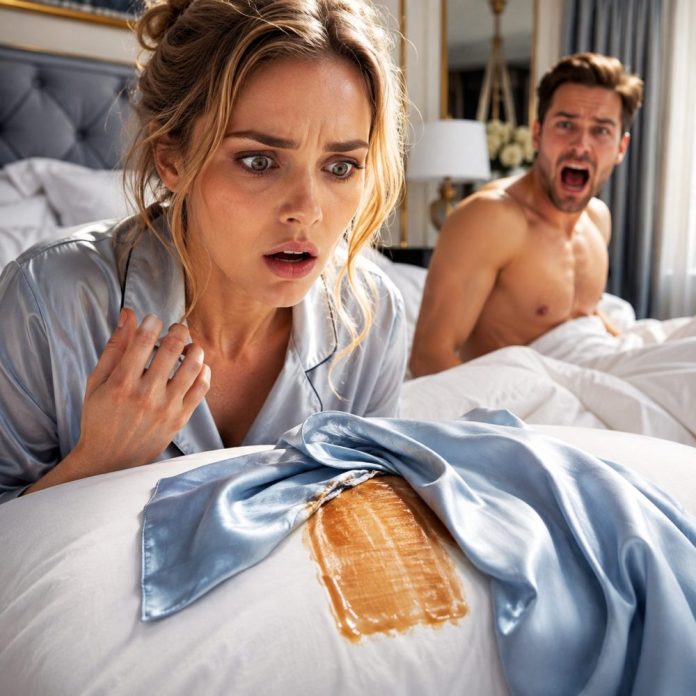
The first time my husband tied the silk scarf around my neck, he kissed the knot and whispered, “A reminder of how much I love you.” Three months later, a stranger held that same scarf beneath a fluorescent lamp and told me, “If you value your life, never wear this again.”
Daniel had given it to me on our seventh anniversary—a pale blue scarf, soft as water, expensive enough that I felt guilty wearing it to work. He insisted I wear it constantly. Breakfast, meetings, grocery runs. If I left without it, he would smile too tightly and say, “Forgotten me already?”
Powered by
GliaStudios
I thought it was possessive in the irritating, almost flattering way insecure husbands could be possessive.
Then I began getting sick.
Headaches first. Then dizziness. My hands trembled during presentations. Twice I forgot simple numbers in front of my finance team. Daniel began answering questions for me at dinners, laughing when I lost my train of thought.
“She’s brilliant before noon,” he joked. “After that, I handle the complicated stuff.”
Everyone laughed.
What they didn’t know was that I had built the analytics company Daniel now strutted through as if it belonged to him. I still controlled fifty-two percent of its voting shares through a trust my late father helped me create. Daniel knew I was wealthy. He did not know how carefully that wealth was protected.
On a rainy Tuesday, I left the scarf on a city bus.
Daniel’s reaction frightened me more than the loss itself.
“You lost it?” His face drained. “Go back.”
“It’s a scarf.”
“Go back, Claire.”
I did.
The driver had found nothing, but an elderly tailor named Mr. Han, who owned a repair shop beside the terminal, waved me inside. He had picked it up from the floor after leaving the same bus.
He ran his fingers along the hem, frowned, then opened one seam with a tiny blade.
Inside was a narrow translucent strip, almost invisible.
Mr. Han’s expression changed.
“My brother worked in medical textiles,” he said quietly. “This is not normal interfacing.”
He sealed the strip in a plastic garment bag.
“Do not touch it with bare skin.”
My mouth went dry.
“I don’t know what it is,” he said. “But someone stitched it here deliberately.”
Then he studied me.
“Tonight, put the scarf under your husband’s pillow. Don’t wear it. Don’t warn him.”
“Why?”
“If he knows what’s inside, his reaction will tell you more than I can.”
At 4:17 a.m., Daniel woke screaming.
Beneath the scarf, staining the white pillowcase, was a greasy amber rectangle exactly where the hidden strip had warmed.
Daniel stared at it.
Then at me.
And whispered, “Oh God.”
PART 2
I didn’t scream. I didn’t accuse him.
I simply said, “What is it, Daniel?”
He snatched the scarf from the pillow, wrapped it in a towel, and rushed toward the bathroom.
That was his first mistake.
His second was assuming I was still dizzy enough to be slow.
I photographed the stain, the open seam, the strip, and the towel. Then I locked myself in the guest room and called the one person Daniel had spent years mocking: my college roommate, Dr. Lena Morris, now director of a private toxicology lab.
By noon, she had arranged secure testing.
By evening, the preliminary result came back.
The strip contained a controlled transdermal compound related to scopolamine, mixed with a solvent designed to release slowly through warmth and moisture. In repeated low doses, Lena explained, it could cause confusion, blurred memory, dizziness, fatigue, and impaired judgment.
Exactly my symptoms.
Every joke he had made about my fading mind suddenly became something much darker.
Daniel returned home carrying flowers.
“You look better,” he said carefully.
“I slept.”
“Good.” His eyes flicked toward my bare neck. “Where’s the scarf?”
“At the cleaner.”
His smile vanished for half a second.
Then it returned.
For four days, I played weak.
I let him pour my wine. I let him finish my sentences. I apologized when I “forgot” meetings. Meanwhile, Lena’s lab completed a certified analysis, and my attorney obtained an emergency preservation order for our home security system, Daniel’s company laptop, and shared cloud accounts.
The truth unfolded quickly.
Daniel had been moving money.
Not enough to trigger automatic fraud alerts—just enough, month after month, into consulting companies owned by his sister, Vanessa. Emails showed they planned to pressure me into signing a “temporary management authorization” giving Daniel broad control during what he called my “cognitive decline.”
One message from Vanessa made my hands shake.
Once she signs, keep her medicated until the board vote. After that, who cares what she remembers?
Daniel replied:
She trusts the scarf. She thinks it’s romantic.
They had even scheduled a neurologist to create a record suggesting early-onset impairment.
That was when I stopped feeling heartbroken.
This was an attempted takeover.
On Friday, Daniel found me at the dining table staring blankly at documents.
He placed a pen beside my hand.
“Claire, sweetheart, this just lets me manage things while you recover.”
Vanessa sat across from me, smiling like she had already redecorated my office.
“You should be grateful,” she said. “Daniel’s protecting what you built.”
I looked at the signature line.
Then at my husband.
“You really think I can’t understand this?”
He squeezed my shoulder.
“I think you’re sick.”
I smiled. “So do I.”
His eyes softened with victory.
He never noticed the tiny red light beneath the bookshelf.
My attorney, a forensic accountant, and two corporate investigators were listening live from the office next door.
Daniel slid the papers closer.
“Sign.”
I picked up the pen and wrote two words across the signature block:
WRONG WOMAN.
PART 3
Daniel’s face changed first.
Vanessa stood so quickly her chair struck the wall.
“What the hell is this?” she snapped.
The door opened before I could answer.
My attorney, Margaret Shaw, entered with two investigators and a police detective.
Daniel went white.
“You wanted me confused,” I said. “So I let you underestimate me for four more days.”
Vanessa grabbed her purse. The detective blocked the doorway.
Margaret placed the lab report, bank transfers, emails, and recorded conversations on the table.
Daniel’s voice cracked. “Claire, listen to me. This is not what it looks like.”
“That sentence should be embroidered on the next scarf you give someone.”
The toxicology report established that the strip sewn into the scarf contained a drug capable of producing the symptoms I had documented for months. Records showed the compound had been obtained through a research supplier using stolen credentials. Security footage showed Daniel opening the anniversary gift box alone the night before he gave it to me.
The financial evidence was cleaner.
Vanessa’s companies had received $640,000 through disguised consulting payments. Their draft plan showed how they would divide my voting control, sell one division, and force me into a guardianship petition if I resisted.
They had planned everything.
Except the trust.
Margaret turned to Daniel.
“Under the founder-protection clauses, any executive credibly implicated in fraud against a controlling shareholder is automatically suspended.”
I slid a folder across the table.
“And my fifty-two percent just removed you from the board.”
Daniel stared at me. “You can’t do this.”
“I did it ten minutes ago.”
Vanessa started crying—not from guilt, but calculation.
“I never touched the scarf.”
“No,” I said. “You only wrote the messages.”
The detective told them the case involved suspected poisoning, conspiracy, identity misuse, and financial fraud. Their lawyers could argue the details later. The arrests that morning were real.
Daniel made one final attempt as they led him away.
“Claire, I loved you.”
I stood.
“No. You loved access.”
Six months later, I sat in the boardroom where Daniel once corrected my numbers for laughs.
Daniel had pleaded guilty to financial fraud and unlawful possession of the drug in exchange for reduced exposure on other charges. Vanessa’s accounts were frozen, her companies collapsed, and she faced conspiracy proceedings.
I recovered most of the stolen money through asset seizures and civil settlements.
More importantly, I recovered myself.
The headaches disappeared within weeks. My memory sharpened. My hands stopped trembling. I returned to work full-time and created a confidential employee fund for victims of domestic financial abuse.
Mr. Han refused the reward I offered him, so I anonymously paid the remaining lease on his tailor shop.
On the cold morning of winter, I walked past a boutique window filled with scarves.
For a moment, I stopped.
Then I smiled, buttoned my coat, and kept walking.
I didn’t need anything tied around my throat to remind me I was truly loved.
I had finally learned the difference between love and a leash.
Disclaimer: This story is a work of fiction created for entertainment purposes. Any resemblance to real persons, events, or places is coincidental.